
World Drowning Prevention Day 2026
Unite to Turn the Tide: An Integrative Public Health Approach to Preventing Drowning
By Livy-Elcon Emereonye
Introduction
There’s no gainsaying the fact that water is indispensable to life, yet it remains one of humanity’s greatest natural hazards. Every year, hundreds of thousands of people lose their lives to drowning, making it one of the world’s leading causes of injury-related deaths. Unlike many public health challenges that require sophisticated technologies or expensive interventions, most drowning incidents are preventable through practical, evidence-based measures and coordinated societal action.
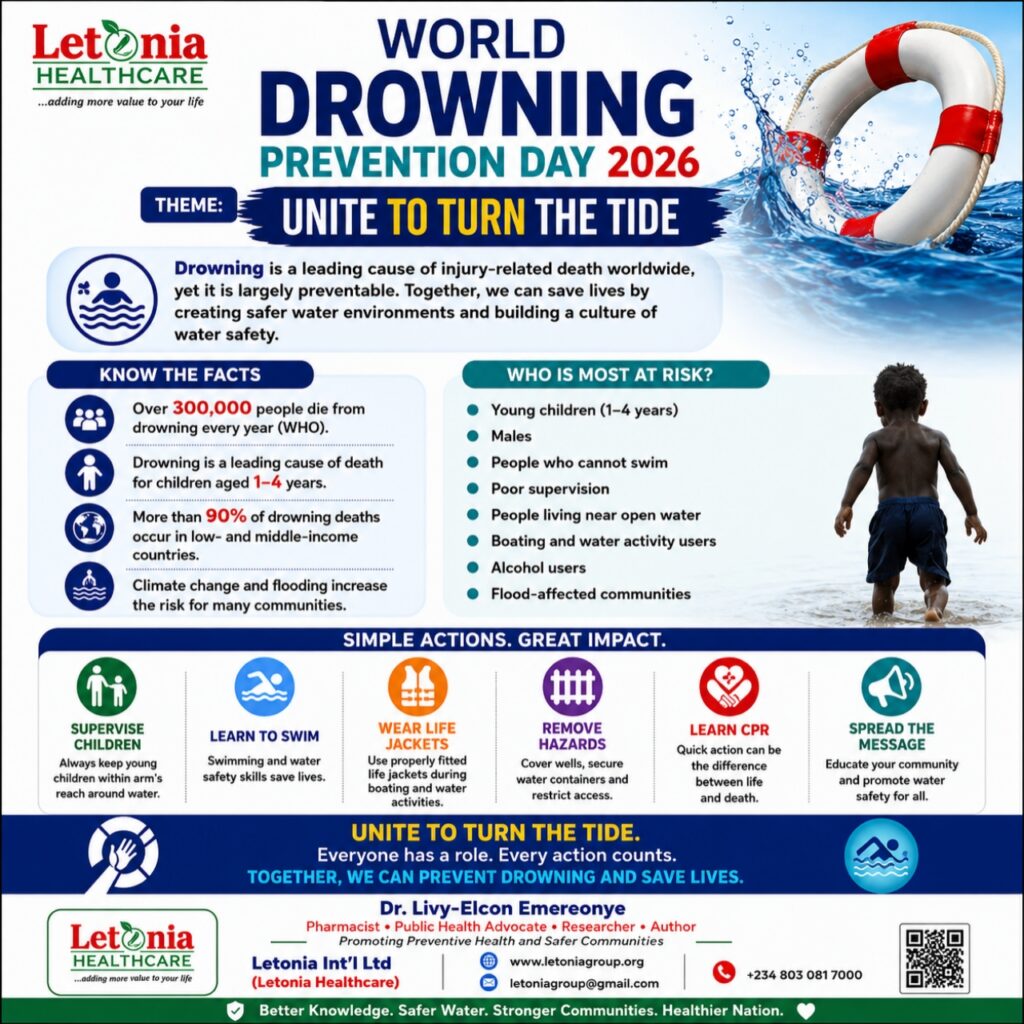
The theme for World Drowning Prevention Day 2026, “Unite to Turn the Tide,” underscores the importance of collective responsibility. Preventing drowning is not solely the responsibility of healthcare professionals or emergency responders; it demands collaboration among governments, educational institutions, families, communities, engineers, environmental planners, policymakers, researchers, and the private sector. Every stakeholder has a role in creating safer water environments and promoting a culture of prevention.
Drowning prevention is particularly important in low- and middle-income countries, where inadequate supervision, poor swimming skills, unsafe water transport, seasonal flooding, and weak enforcement of safety regulations contribute to high mortality. As climate change increases the frequency of floods and extreme weather events, the urgency of comprehensive drowning prevention strategies has never been greater.
Understanding Drowning
The World Health Organization (WHO) defines drowning as “the process of experiencing respiratory impairment from submersion or immersion in liquid.” The outcome may be fatal or non-fatal, with survivors either recovering completely or suffering permanent neurological injury due to prolonged oxygen deprivation.
Contrary to popular belief, drowning is often silent. Victims are usually unable to shout because breathing becomes the body’s immediate priority. Children can disappear beneath the water in seconds without attracting attention. Consequently, rapid recognition and prompt rescue are critical determinants of survival.
Drowning may occur in oceans, rivers, lakes, ponds, wells, irrigation canals, water storage containers, bathtubs, and swimming pools. It can also result from floods, maritime disasters, recreational activities, occupational exposure, and road traffic incidents involving submerged vehicles.
The Global Burden of Drowning
According to the World Health Organization, an estimated 300,000 people die from drowning each year, making it one of the leading causes of unintentional injury deaths globally. Millions more experience non-fatal drowning, often resulting in long-term disability and psychological trauma.
Children under five years of age are particularly vulnerable because of their curiosity, limited understanding of danger, and dependence on adult supervision. Drowning is also a leading cause of death among children and young people aged 1–24 years. More than 90% of drowning deaths occur in low- and middle-income countries, where poverty, inadequate infrastructure, unsafe water environments, and limited emergency services amplify the risks.
The true burden of drowning is probably underestimated because deaths associated with floods, transportation accidents, and natural disasters are frequently recorded under other categories. Improved surveillance systems are therefore essential for understanding the full magnitude of the problem and guiding effective prevention strategies.
Risk Factors
Scientific evidence has identified several factors that increase the likelihood of drowning.
Young children are at particularly high risk because they often wander unsupervised near water. Males consistently experience higher drowning rates than females, partly because of greater participation in water-related occupations and recreational activities and a higher tendency toward risk-taking behaviours.
Lack of swimming ability remains one of the strongest predictors of drowning. In many communities, formal swimming instruction is unavailable or unaffordable. Alcohol and recreational drug use impair judgment, coordination, and reaction time, increasing the likelihood of fatal incidents during boating, fishing, or swimming.
Environmental factors also play a major role. Uncovered wells, irrigation canals, poorly protected reservoirs, overcrowded boats, and flood-prone communities expose millions of people to avoidable hazards. Climate change, which has intensified flooding and severe weather events, further compounds these risks.
Health Consequences of Drowning
When a person is submerged, water interferes with normal breathing, causing oxygen deprivation. As oxygen levels fall, vital organs begin to fail. The brain is particularly sensitive to hypoxia, and irreversible neurological damage may occur within minutes if effective resuscitation is delayed.
Complications of drowning include respiratory failure, aspiration pneumonia, cardiac arrest, acute respiratory distress syndrome, and severe brain injury. Survivors may suffer long-term impairments affecting memory, speech, movement, learning, and emotional well-being. Families also experience significant psychological, social, and economic burdens following drowning incidents.
**Evidence-Based Prevention Strategies
Research demonstrates that drowning can be significantly reduced through coordinated interventions.
Teaching swimming and water survival skills is among the most effective preventive measures. Swimming programmes should include floating, treading water, safe entry and exit techniques, hazard recognition, and basic rescue principles. Water competency empowers individuals to respond more effectively during emergencies.
Children should never be left unattended near water. Constant, close, and capable supervision remains one of the simplest and most effective methods of preventing childhood drowning. Parents and caregivers should avoid distractions such as mobile phones while supervising children around water.
Environmental modifications are equally important. Swimming pools should be enclosed with self-closing gates and protective fencing. Wells, water storage containers, and drainage systems should be securely covered. Warning signs should be installed around hazardous water bodies, and communities should identify and address local environmental risks.
The consistent use of properly fitted life jackets dramatically reduces fatalities associated with boating and water transport. Governments should enforce regulations requiring life jackets for passengers, fishermen, and recreational water users while ensuring compliance with vessel safety standards and passenger limits.
Public education campaigns should encourage people to avoid alcohol during water activities, respect weather advisories, and learn basic cardiopulmonary resuscitation (CPR). Community awareness significantly strengthens individual responsibility and promotes safer behaviour.
The Nigerian Perspective
Nigeria’s extensive coastline, rivers, lakes, dams, and inland waterways create both opportunities and risks. Seasonal flooding, overcrowded boats, inadequate safety equipment, and poor enforcement of water transport regulations contribute to recurring drowning incidents across the country.
Many rural communities depend on rivers and lakes for transportation, fishing, domestic activities, and agriculture. Children frequently play near water bodies without adequate supervision, while flood disasters continue to threaten vulnerable populations during the rainy season.
Strengthening drowning surveillance, expanding swimming education, enforcing maritime safety regulations, and improving emergency response systems should become important national public health priorities.
Integrative Management Approach
An effective response to drowning extends beyond emergency rescue. It requires an integrative management approach that combines prevention, clinical care, rehabilitation, public education, environmental safety, policy development, and community participation. Such a comprehensive strategy reflects the spirit of “Unite to Turn the Tide.”
Health promotion should form the cornerstone of every drowning prevention programme. Continuous public education through schools, healthcare facilities, workplaces, religious institutions, traditional leadership structures, and the mass media can improve awareness of water hazards and encourage safer behaviours. Parents, teachers, fishermen, boat operators, and young people should all receive targeted education on water safety.
Communities themselves are indispensable partners. Local organizations can identify dangerous water sites, establish volunteer rescue teams, organize swimming lessons, and advocate for safer environments. Community ownership increases sustainability and encourages collective responsibility.
Environmental and engineering measures should complement educational efforts. Protective fencing around swimming pools, barriers around irrigation canals, covered wells, improved drainage systems, flood-control infrastructure, and clearly marked danger zones all reduce exposure to hazards. Urban planning should incorporate water safety into community development.
Healthcare systems must also be prepared to respond effectively. Emergency medical services should be strengthened through improved ambulance networks, rapid communication systems, trained first responders, and hospitals equipped to provide advanced resuscitation and intensive care. Prompt CPR, oxygen therapy, and specialized post-resuscitation management significantly improve survival and neurological outcomes.
Mental health support is often overlooked but remains an important component of comprehensive care. Survivors of drowning may experience anxiety, depression, or post-traumatic stress disorder, while bereaved families frequently require psychological counselling and social support. Integrating mental health services into rehabilitation programmes promotes holistic recovery.
Climate adaptation strategies should also incorporate drowning prevention. Early warning systems, evacuation plans, community flood education, and resilient infrastructure can substantially reduce disaster-related drowning. As climate change increases the frequency of extreme weather events, integrating drowning prevention into disaster risk reduction policies becomes increasingly important.
The Role of Integrative Medicine
Integrative medicine offers valuable contributions to drowning prevention through health promotion, rehabilitation, and patient-centred care. It should be emphasized, however, that acute drowning is a medical emergency requiring immediate evidence-based emergency management, including rescue, airway support, CPR when indicated, oxygen therapy, and hospital care. Complementary therapies should never replace these lifesaving interventions.
Following medical stabilization, an integrative approach may support recovery by combining conventional rehabilitation with evidence-based complementary interventions. Nutritional optimization, structured physical rehabilitation, psychological counselling, stress-reduction techniques, family support, and lifestyle modification can improve functional recovery and quality of life. These interventions should be individualized and guided by qualified healthcare professionals.
Integrative medicine practitioners can also strengthen prevention by promoting physical fitness, encouraging swimming competency, supporting community education, and advocating healthy lifestyles that improve resilience and overall well-being. This multidisciplinary approach recognizes that preventing drowning requires attention not only to emergency response but also to education, environmental safety, rehabilitation, and community engagement.
Research, Policy, and Innovation
Reliable data remain essential for effective public health planning. Governments should establish comprehensive drowning surveillance systems that accurately capture information on where, how, and why drowning occurs. Such data enable policymakers to identify high-risk populations and allocate resources efficiently.
Research should continue to evaluate behavioural interventions, rescue technologies, climate-related risks, and innovative prevention strategies. Emerging technologies—including drone-assisted rescue, artificial intelligence for flood prediction, wearable flotation devices, GPS-enabled emergency systems, and mobile early warning platforms—have the potential to strengthen existing interventions.
Legislation also plays a critical role. Governments should develop national drowning prevention strategies, enforce safe boating regulations, mandate life-jacket use, improve swimming education, and integrate drowning prevention into national public health and disaster management policies.
In conclusion, World Drowning Prevention Day 2026 reminds us that drowning is not an inevitable accident but a preventable public health challenge. The theme “Unite to Turn the Tide” calls upon governments, healthcare professionals, educators, researchers, engineers, community leaders, civil society organizations, and individuals to work together in protecting lives.
Scientific evidence clearly demonstrates that a combination of swimming education, vigilant supervision, environmental modifications, safe boating practices, emergency preparedness, effective legislation, and community engagement can dramatically reduce drowning deaths. When these evidence-based measures are strengthened through an integrative approach that incorporates prevention, rehabilitation, mental health support, climate adaptation, and multidisciplinary collaboration, the impact becomes even greater.
Every life saved from drowning represents a family preserved from grief, a community strengthened, and a nation’s human capital protected. Preventing drowning is therefore not merely a water safety issue—it is an investment in public health, sustainable development, and social well-being.
As we commemorate World Drowning Prevention Day 2026, let us transform awareness into action and commitment into measurable results. By uniting our knowledge, resources, and determination, we can indeed turn the tide against drowning and build a future in which every individual can enjoy the benefits of water safely and responsibly.
PS: Dr. Emereonye could be reached on: +234 803 3922 445
References
1. World Health Organization. Drowning. https://www.who.int/news-room/fact-sheets/detail/drowning
2. World Health Organization. Global Status Report on Drowning Prevention. Geneva: WHO; 2024.
3. World Health Organization. Preventing Drowning: An Implementation Guide. Geneva: WHO; 2017.
4. United Nations General Assembly. Resolution A/RES/75/273: Global Drowning Prevention. New York: United Nations; 2021.
5. United Nations. World Drowning Prevention Day. https://www.un.org/en/observances/drowning-prevention-day
6. Centers for Disease Control and Prevention. Unintentional Drowning: Get the Facts. https://www.cdc.gov/drowning
7. Franklin RC, Peden AE, Hamilton EB, et al. The burden of unintentional drowning: global, regional and national estimates. Injury Prevention. 2020;26(Suppl 1):i83–i95.
8. Hyder AA, Sugerman DE, Puvanachandra P, et al. Global childhood unintentional injury surveillance in four cities in developing countries: a pilot study. Bulletin of the World Health Organization. 2009;87(5):345–352.
9. World Health Organization, UNICEF. World Report on Child Injury Prevention. Geneva: WHO; 2008.
10. American Heart Association. Highlights of the Guidelines for CPR and ECC. Latest edition.If you intend to publish this in a national newspaper or a professional health magazine, I can further refine it into a more editorial, high-impact style while maintaining the scientific content and keeping it within the 2,000–2,500-word target
Leave a comment