
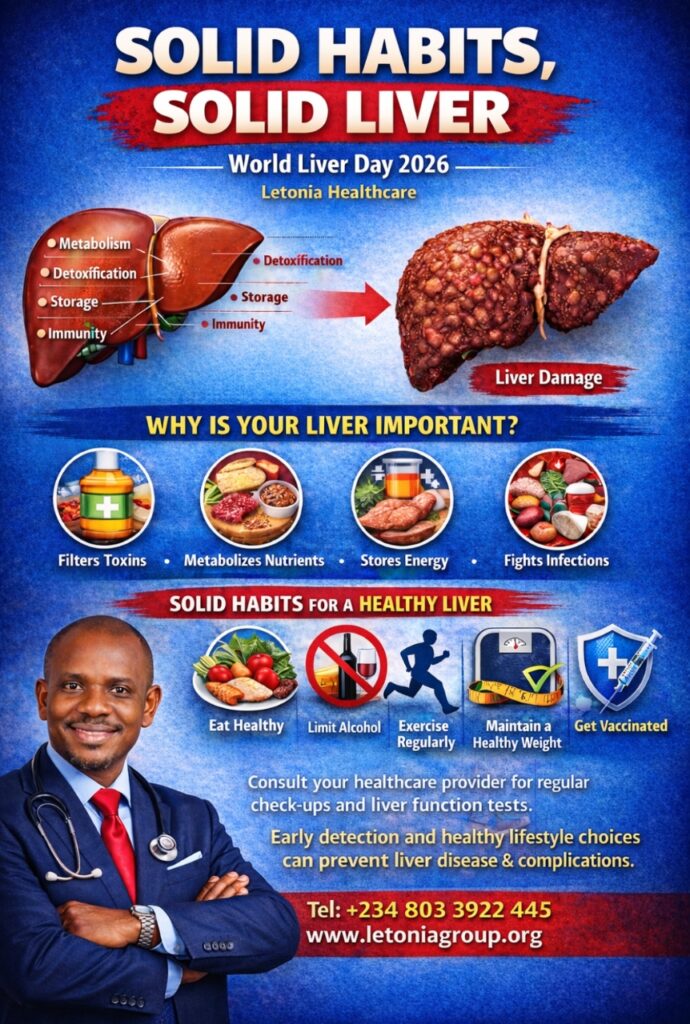
SOLID HABITS, SOLID LIVER:
Being a scientistific exploration to mark the 2026 World Liver
By Livy-Elcon Emereonye
Abstract
The liver is one of the most vital yet underappreciated organs in human physiology, executing over 500 essential functions that sustain metabolic balance, detoxification, immunity, and homeostasis. Despite its regenerative capacity and resilience, liver disease remains a leading cause of morbidity and mortality worldwide. The 2026 World Liver Day theme, “Solid Habits, Solid Liver,” underscores the critical role of lifestyle and behavioral choices in preserving hepatic integrity. This article presents a comprehensive, polemical–scientific analysis of liver function, the epidemiology and pathophysiology of liver diseases, and evidence-based integrative management strategies. It argues that modern lifestyles are fundamentally hepatotoxic and advocates for a paradigm shift toward preventive, integrative, and systems-based healthcare approaches.
1. Introduction:
The Silent Sovereign of Human Physiology
The liver is not merely an organ—it is a biochemical command center. Weighing approximately 1.2–1.5 kg in adults, it is the largest internal organ and performs a staggering array of functions essential for survival (Hall & Hall, 2021). Yet, despite its centrality, liver health is often neglected until disease becomes advanced and symptomatic.
Unlike organs such as the heart or brain, the liver does not readily signal distress. It lacks pain receptors, allowing pathological processes to progress silently. This biological stoicism, while evolutionarily advantageous, contributes to late diagnosis and poor outcomes in liver disease.
The theme “Solid Habits, Solid Liver” is therefore both preventive and corrective. It emphasizes that hepatic health is not accidental but the cumulative result of daily decisions—nutritional, behavioral, environmental, and clinical.
2. The Liver:
Anatomy and Functional Complexity
2.1 Structural Overview
The liver is located in the right upper quadrant of the abdomen and receives dual blood supply:
Hepatic artery (oxygen-rich blood)
Portal vein (nutrient-rich blood from the gastrointestinal tract)
This dual supply enables the liver to act as a metabolic processing hub, filtering and modifying substances before they enter systemic circulation.
2.2 Core Functions of the Liver
2.2.1 Metabolic Regulation
The liver maintains glucose homeostasis through glycogenesis, glycogenolysis, and gluconeogenesis. It also metabolizes lipids and proteins, producing cholesterol, triglycerides, and urea (Hall & Hall, 2021).
2.2.2 Detoxification
Through Phase I (cytochrome P450 enzymes) and Phase II reactions, the liver neutralizes toxins, drugs, and metabolic waste (Klaassen, 2019).
2.2.3 Synthetic Functions
The liver synthesizes:
– Albumin (maintains oncotic pressure)
– Clotting factors (II, VII, IX, X)
– Bile acids (fat digestion)
2.2.4 Storage
It stores glycogen, fat-soluble vitamins (A, D, E, K), vitamin B12, and minerals like iron and copper.
2.2.5 Immunological Role
Kupffer cells (hepatic macrophages) play a crucial role in innate immunity by removing pathogens and debris.
3. Global Burden of Liver Disease
Liver diseases account for approximately 2 million deaths annually worldwide, with cirrhosis and liver cancer being leading causes (Asrani et al., 2019). In sub-Saharan Africa, including Nigeria, viral hepatitis and aflatoxin exposure significantly contribute to hepatocellular carcinoma incidence.
The epidemiological transition has introduced a new dominant player: Metabolic Dysfunction-Associated Steatotic Liver Disease (MASLD), formerly NAFLD. It now affects about 25–30% of the global population (Younossi et al., 2018).
4. Classification and Pathophysiology of Liver Diseases
4.1 Metabolic Liver Disease (MASLD/NAFLD)
Etiology: Obesity, insulin resistance, high-fructose diets
Pathogenesis: Lipid accumulation → oxidative stress → inflammation → fibrosis
Clinical Spectrum: Simple steatosis → steatohepatitis → cirrhosis
This condition represents the hepatic manifestation of metabolic syndrome.
4.2 Alcoholic Liver Disease (ALD)
Cause: Chronic alcohol consumption
Mechanism: Ethanol metabolism produces acetaldehyde and reactive oxygen species, causing hepatocyte injury
Stages:
– Steatosis
– Alcoholic hepatitis
– Cirrhosis
Contrary to popular belief, there is no completely “safe” threshold for alcohol in susceptible individuals.
4.3 Viral Hepatitis
Hepatitis A & E
Fecal-oral transmission
Typically acute and self-limiting
Hepatitis B & C
Blood-borne and sexual transmission
High risk of chronic infection
Complications: Cirrhosis, hepatocellular carcinoma
Nigeria bears a high burden of Hepatitis B, with prevalence estimates around 8–12% (WHO, 2023).
4.4 Cirrhosis
Cirrhosis represents the end-stage of chronic liver injury, characterized by fibrosis and nodular regeneration.
Consequences:
– Portal hypertension
– Ascites
– Hepatic encephalopathy
– Variceal bleeding
4.5 Hepatocellular Carcinoma (HCC)
HCC is the most common primary liver cancer.
Risk Factors:
– Chronic hepatitis B/C
– Cirrhosis
– Aflatoxin exposure
Africa has one of the highest HCC incidence rates globally due to synergistic risk factors.
4.6 Drug-Induced Liver Injury (DILI)
Causes:
– Paracetamol overdose
– Antibiotics
– Herbal products abuse
DILI is a leading cause of acute liver failure globally (Chalasani et al., 2015).
4.7 Autoimmune Liver Diseases
Autoimmune hepatitis
Primary biliary cholangitis
Primary sclerosing cholangitis
These conditions involve immune-mediated destruction of hepatic tissue.
4.8 Genetic Liver Disorders
Hemochromatosis: Iron overload
Wilson’s disease: Copper accumulation
Alpha-1 antitrypsin deficiency
4.9 Toxic Liver Injury
Particularly relevant in Africa due to aflatoxins, produced by fungi in poorly stored grains.
5. Polemical Perspective:
The Modern Assault on the Liver
Modern lifestyles are not neutral—they are hepatotoxic by design.
Ultra-processed foods overload metabolic pathways
Excess fructose is converted directly into liver fat
Alcohol is socially normalized despite toxicity
Sedentary behavior promotes insulin resistance
Unregulated herbal mixtures introduce unpredictable toxins
This is not merely a health issue—it is a systemic failure of culture, policy, and education.
6. Integrative Management of Liver Diseases
An effective strategy must transcend reductionist medicine and embrace integrative care, combining biomedical, nutritional, and lifestyle interventions.
6.1 Nutritional Medicine
Diet is the cornerstone of liver health.
Recommended:
– High-fiber diets
– Vegetables (especially cruciferous)
– Omega-3 fatty acids
– Antioxidant-rich foods
Avoid:
– Refined sugars
– Trans fats
– Excess alcohol
The Mediterranean diet has shown strong evidence in improving liver outcomes (Eslam et al., 2020).
6.2 Conventional Medical Therapies
Antivirals (e.g., tenofovir, sofosbuvir)
Immunosuppressants
Insulin sensitizers
Surveillance for HCC
6.3 Phytotherapy (Evidence-Based Herbal Medicine)
Silymarin (Milk Thistle): Hepatoprotective
Curcumin: Anti-inflammatory
Phyllanthus niruri: Antiviral activity
Vernonia amygdalina (Bitter leaf): Indigenous therapeutic relevance etc
Caution: Herbal therapies must be standardized and clinically supervised.
6.4 Lifestyle Medicine
Regular exercise (≥150 minutes/week)
Weight management
Sleep hygiene
Stress reduction
6.5 Preventive Public Health Measures
Vaccination (Hepatitis A & B)
Safe medical practices
Food safety regulations
Public awareness campaigns
6.6 Detoxification: A Scientific Clarification
The liver detoxifies itself. Extreme “cleanses” lack scientific backing and may be harmful. Supporting liver function involves:
– Hydration
– Balanced nutrition
– Avoidance of toxins
7. Solid Habits:
The Foundation of Liver Longevity
The concept of “solid habits” is grounded in behavioral science and preventive medicine.
Key habits include:
– Conscious nutrition
– Alcohol moderation or abstinence
<span;><span;>- Routine screening
– Safe medication practices
– Physical activity
8. Future Directions:
Toward Integrative Hepatology
The future of liver care lies in:
– Personalized medicine
– Microbiome research
– Nutrigenomics
– Integration of traditional and modern therapies
9. Conclusion:
The Liver Keeps the Record
The liver is both forgiving and unforgiving. It adapts, compensates, and regenerates—but only to a point.
Every dietary excess, every toxin, every neglected habit is recorded in hepatic tissue. The consequences may be silent, but they are cumulative.
The message of World Liver Day 2026 is clear:
“Solid habits are not optional—they are the biochemical foundation of life.”
Protect the liver, and you preserve vitality. Neglect it, and disease becomes inevitable.
PS: Dr. Emereonye could be reached on: +234 803 3922 445
References
1. Asrani SK, et al. (2019). Burden of liver diseases in the world. Journal of Hepatology.
2. Chalasani NP, et al. (2015). Drug-induced liver injury. Gastroenterology.
3. Eslam M, et al. (2020). MAFLD: A consensus-driven proposed nomenclature. Journal of Hepatology.
4. Hall JE, Hall ME. (2021). Guyton and Hall Textbook of Medical Physiology.
5. Klaassen CD. (2019). Casarett & Doull’s Toxicology.
6. World Health Organization (2023). Global Hepatitis Report.
7. Younossi ZM, et al. (2018). Global epidemiology of NAFLD. Hepatology.
8. European Association for the Study of the Liver (EASL). (2021). Clinical Practice Guidelines.
9. American Association for the Study of Liver Diseases (AASLD). (2022). Practice Guidance
Leave a comment