Where Diagnosis Becomes Hope: The Power of Collaboration and Technology in Rare Diseases
By Livy-Elcon Emereonye
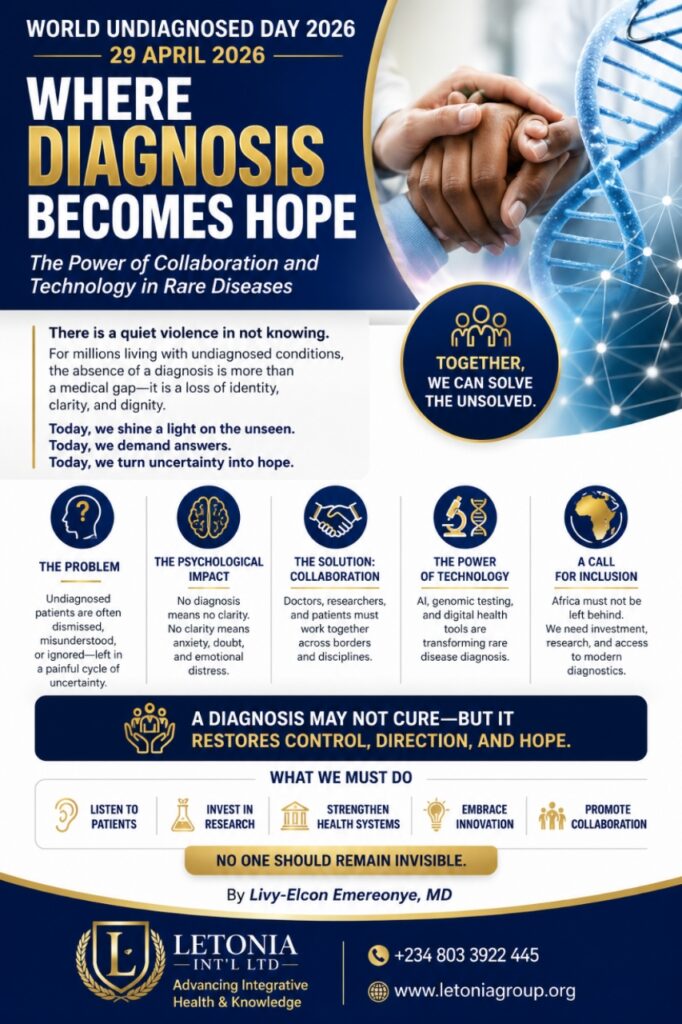
World Undiagnosed Day — 29 April 2026
There is a quiet violence in not knowing.
It does not bleed. It does not scream. It does not collapse the body in spectacle. It lingers—unseen, unnamed, and therefore unaddressed. For millions living with undiagnosed conditions, the absence of a diagnosis is not just a medical gap; it is a fracture of identity, dignity, and psychological stability.
Today, 29 April 2026, as we mark World Undiagnosed Day, we confront a hard truth: modern medicine, for all its power, still leaves too many behind. And too often, it does so quietly.
Yet within that silence, something is shifting. Collaboration is rising. Technology is accelerating. And in that convergence, diagnosis is becoming hope.
The Cruel Psychology of Uncertainty
To be undiagnosed is to live in suspension—neither fully ill nor fully believed.
Patients are dismissed as exaggerators. Their symptoms are labeled “stress,” “psychosomatic,” or worse, ignored. But the deeper damage is psychological. Humans are wired for meaning. We need names, explanations, anchors.
A diagnosis is more than a label—it is a narrative. It answers the relentless question: What is wrong with me?
Without it, patients drift.
Uncertainty breeds anxiety, depression, and self-doubt. Over time, many begin to question their own reality. Trust erodes—first in the system, then in themselves. This is the hidden brutality of undiagnosed disease: it destabilizes both body and mind, while remaining invisible to society.
Medicine Must Do Better
Let’s be candid—this is not just biology failing. It is systems failing.
Modern medicine is optimized for patterns, not anomalies. Doctors are trained to recognize the familiar, not to pursue the rare. When symptoms fall outside known frameworks, patients are often sidelined, referred endlessly, or dismissed outright.
Efficiency has quietly replaced curiosity.
But every undiagnosed patient is not an inconvenience—they are a challenge to medical thinking. If medicine is truly scientific, then the unknown is not a nuisance. It is the frontier.
Collaboration Is Not Optional
No single clinician can solve the puzzle of undiagnosed disease alone. Complexity demands collective intelligence.
When neurologists, geneticists, immunologists, psychologists, and data scientists converge, blind spots shrink. When global networks share cases in real time, distance becomes irrelevant. A baffling case in Owerri may find clarity in Berlin—or Boston.
And patients? They are no longer passive.
Across digital platforms and advocacy networks, they are organizing, sharing data, identifying patterns, and shaping research. This is a quiet but powerful shift—from hierarchy to partnership.
Those who live the illness often understand it in ways textbooks never will.
Technology Is Rewriting the Rules
If collaboration is the engine, technology is the accelerant.
Genomic sequencing now reveals what symptoms conceal. AI detects patterns the human eye might miss. Wearables generate continuous health data, turning patients into real-time case studies.
Diseases that once lingered in mystery are now being decoded at the molecular level.
But let’s be clear—technology is not magic. Without access, it becomes another layer of inequality. Without ethics, it becomes dangerous. Innovation must be matched with inclusion, or it will simply deepen the divide.
Africa Cannot Be Left Behind
In Nigeria and across Africa, undiagnosed diseases expose deeper systemic gaps—limited diagnostic tools, specialist shortages, fragile infrastructure.
But this is not a dead end. It is an inflection point.
Africa can leapfrog outdated systems through telemedicine, mobile health, and decentralized diagnostics. What is needed is intentional investment—in infrastructure, in training, and critically, in research.
African genetic diversity remains underrepresented globally. That absence is not academic—it directly contributes to missed diagnoses.
If global health is to be truly global, Africa must be seen, studied, and prioritized.
Diagnosis Is Power
A diagnosis does not always cure—but it transforms.
It restores clarity. It ends the guessing. It replaces doubt with direction.
Patients move from confusion to strategy. From isolation to community. From invisibility to recognition.
Even without a cure, a name changes everything.
Hope, in this context, is not wishful thinking. It is informed, grounded, and actionable.
A Moral Obligation
This is not just a medical issue. It is an ethical one.
To remain undiagnosed is to be denied understanding of one’s own body. It is a form of medical invisibility that disproportionately affects the vulnerable.
Healthcare systems must be held accountable. Governments must invest. Institutions must reward curiosity, not just speed.
This is not charity.
It is justice.
Strength Without Romanticism
Yes, many patients develop extraordinary resilience. They become advocates, researchers, and community builders. They turn uncertainty into movement.
But resilience should not be glorified as a solution.
It is a response to neglect—not a replacement for responsibility.
The Road Ahead
Will we eliminate all undiagnosed diseases? Unlikely.
Biology is too complex.
But we can do far better. We can shorten diagnostic journeys. We can reduce dismissal. We can build systems that treat uncertainty as a beginning—not a dead end.
And we can ensure that no patient is left unheard.
Final Thought
World Undiagnosed Day is not just a date. It is a reckoning.
A call to confront the blind spots of medicine.
A call to amplify collaboration.
A call to democratize technology.
A call to restore dignity through diagnosis.
Because a diagnosis is not merely a conclusion.
It is recognition.
And for those who have lived too long in uncertainty, recognition is where hope begins.
PS: Dr. Emereonye could be reached on: +234 803 3922 445
Leave a comment