Integrative Approach to Dealing with the Malaria Menace: A Holistic Scientific Perspective
Aligned with the 2026 World Malaria Day Theme: “Drive to End Malaria: Now We Can. Now We Must.”
By Livy-Elcon Emereonye
Abstract
Malaria remains one of the most persistent and devastating infectious diseases globally, exerting a disproportionate burden on sub-Saharan Africa. Despite decades of progress in vector control, diagnostics, and pharmacotherapy, malaria continues to claim hundreds of thousands of lives annually, reflecting a complex interplay of biological, environmental, socio-economic, and systemic determinants. The 2026 World Malaria Day theme—“Drive to End Malaria: Now We Can. Now We Must.”—captures both the unprecedented opportunity and urgent responsibility to eliminate malaria using available tools and innovative strategies.
This paper presents a comprehensive, multidisciplinary, and integrative analysis of malaria, encompassing its epidemiology, etiology, pathophysiology, clinical manifestations, diagnosis, and treatment. It critically evaluates the role of antibiotics, explores host genetic factors such as ABO blood groups, and examines the relevance of herbaceutically formulated products like Kuriba® Capsules (Letonia Int’l Ltd) within evidence-based integrative care.
Furthermore, the article advances a systems-based integrative framework that incorporates herbal medicine, nutritional optimization, environmental management, behavioral change, and health system strengthening. It argues that malaria elimination is no longer constrained by lack of knowledge or tools, but by gaps in implementation, integration, and political will. The paper concludes that achieving malaria elimination requires a deliberate fusion of science, policy, community engagement, and innovation.
1. Introduction
Malaria has long been both a biomedical challenge and a socio-political burden. Caused by protozoan parasites of the genus Plasmodium and transmitted by female Anopheles mosquitoes, malaria continues to threaten nearly half of the global population.
According to the World Health Organization (WHO), there were approximately 249 million cases and 608,000 deaths globally in 2022, with over 94% occurring in Africa (WHO, 2023). Nigeria alone accounts for nearly 27% of global malaria cases, making it the epicenter of the global malaria burden.
Yet, paradoxically, humanity has never been better equipped to end malaria. We now possess:
Highly effective artemisinin-based combination therapies (ACTs)
Proven preventive tools such as insecticide-treated nets (ITNs) and indoor residual spraying (IRS)
Emerging vaccines (RTS,S and R21)
Advanced diagnostic technologies
Expanding knowledge of genomics, immunology, and vector ecology
The persistence of malaria despite these tools highlights a critical reality: malaria is not merely a parasitic disease—it is a systems disease.
The 2026 theme challenges global health actors to move from capability to commitment, from knowledge to action, and from fragmentation to integration.
2. Definition and Epidemiology
Malaria is an acute and sometimes chronic febrile illness caused by Plasmodium parasites, transmitted primarily through bites of infected female Anopheles mosquitoes.
Major Species Affecting Humans
Plasmodium falciparum (most lethal; dominant in Africa)
Plasmodium vivax (relapsing malaria; global distribution)
Plasmodium ovale
Plasmodium malariae
Plasmodium knowlesi (zoonotic; Southeast Asia)
Global and Regional Epidemiology
Malaria transmission is shaped by climate, ecology, and socio-economic conditions:
Sub-Saharan Africa: High, stable transmission
South-East Asia & Latin America: Moderate transmission
Seasonality: Peaks during rainy seasons
Urbanization: Alters transmission patterns
High-Risk Groups
Children under five
Pregnant women
Immunocompromised individuals (e.g., HIV/AIDS)
Migrant and displaced populations
Malaria is both a disease of poverty and a driver of poverty, perpetuating cycles of reduced productivity, healthcare costs, and educational disruption.
3. Etiology and Pathophysiology
Etiology
Transmission pathways include:
Mosquito bites (primary)
Blood transfusion (rare)
Congenital transmission
Life Cycle
1. Sporozoite Stage (Liver Phase)
Parasites invade hepatocytes and multiply silently.
2. Merozoite Stage (Blood Phase)
Parasites infect red blood cells (RBCs), causing cyclical rupture.
3. Gametocyte Stage
Transmissible forms taken up by mosquitoes.
Pathophysiological Mechanisms
Hemolysis → Anemia
Cytoadherence & Sequestration (P. falciparum)
Rosetting (linked to blood groups)
Cytokine storm → Fever & inflammation
Microvascular obstruction → organ dysfunction
Severe malaria results from a combination of parasite virulence and host immune response dysregulation.
4. Risk Factors
Environmental Determinants
Stagnant water bodies
Poor drainage systems
Climate variability (temperature, rainfall)
Socio-economic Determinants
Poverty and inequality
Poor housing
Limited healthcare access
Biological Determinants
Age
Pregnancy
Immunosuppression
Systemic Determinants
Weak health systems
Poor surveillance
Inadequate policy implementation
5. Blood Group and Malaria: A Genetic Lens
Host genetics significantly influence malaria outcomes.
Key Findings
Blood group O → protective against severe malaria
Blood groups A, B, AB → increased severity
Mechanism
Reduced rosetting in group O
Lower microvascular obstruction
Implications
Precision public health strategies
Risk stratification in endemic regions
This insight reinforces malaria as a host–parasite–environment interaction, not merely an infection.
6. Clinical Features
Uncomplicated Malaria
Fever
Chills
Headache
Myalgia
Fatigue
Severe Malaria
Severe anemia
Cerebral malaria
Acute respiratory distress
Renal failure
Hypoglycemia
7. Diagnosis
Standard Methods
Microscopy (gold standard)
Rapid Diagnostic Tests (RDTs)
PCR (high sensitivity)
Supportive Tests
Full blood count
Liver and renal function tests
Accurate diagnosis is critical to avoid misuse of antimalarials and antibiotics.
8. Treatment Strategies
8.1 Conventional Therapy
ACTs (first-line)
Artesunate for severe malaria
Supportive care
Challenges
Drug resistance
Poor adherence
Counterfeit medicines
8.2 Role of Antibiotics
Though not primary treatments, antibiotics play a role in:
Co-infections (e.g., typhoid, pneumonia)
Severe malaria (empirical therapy)
Adjunct therapy (e.g., doxycycline)
Caution
Unchecked use fuels antimicrobial resistance (AMR).
9. Integrative Medicine Approach
The central argument of this paper is that malaria elimination requires integration, not substitution.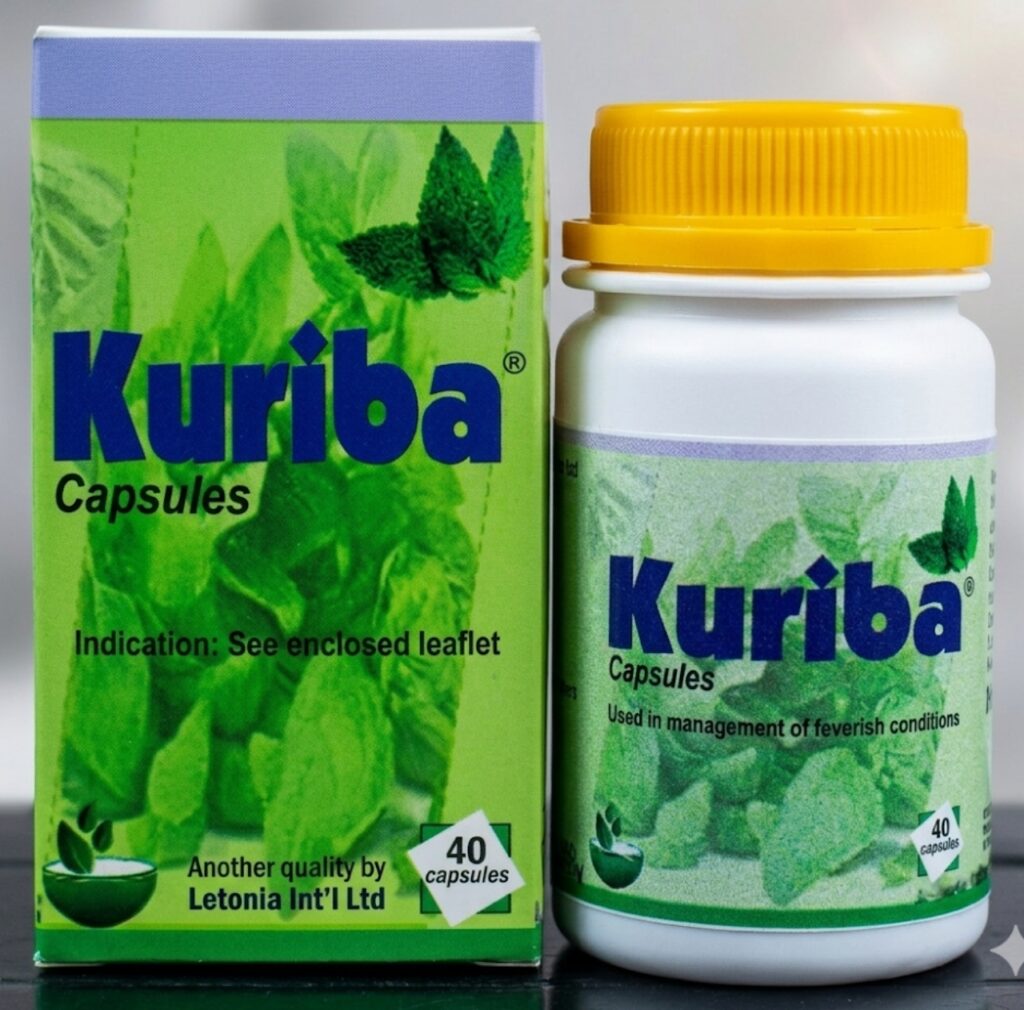
9.1 Herbal Medicine and Herbaceutics
Africa’s biodiversity offers immense therapeutic potential.
Key Plants
Artemisia annua
Azadirachta indica (Neem)
Morinda lucida
Alstonia boonei
Herbaceutics and Standardization
Herbaceutics bridges traditional medicine and modern pharmacology.
Case Example: Kuriba® Capsules
Standardized herbal formulation
Designed for consistency, safety, and efficacy
Clinical Positioning
Adjunct to standard therapy
Supportive care during recovery
Scientific Imperatives
Clinical trials
Toxicology studies
Regulatory compliance (e.g., NAFDAC)
9.2 Nutritional Support
Nutrition directly influences immunity and recovery.
Iron → anemia correction
Zinc → immune function
Vitamins A, C, D → antioxidant support
9.3 Environmental Management
Elimination of breeding sites
Waste management
Drainage systems
Biological controls
9.4 Behavioral Interventions
Use of ITNs
Early treatment-seeking
Community education
9.5 Health System Integration
Collaboration across disciplines
Strengthening primary healthcare
Digital surveillance
10. Prevention Strategies
ITNs
IRS
IPT (pregnancy, infants)
Vaccines (RTS,S, R21)
 11. Discussion: From Control to Elimination
The theme “Now We Can. Now We Must.” reflects a turning point.
What Has Changed?
Tools exist
Knowledge is sufficient
Technology is advancing
What Is Missing?
Political will
Systems integration
Community ownership
Malaria elimination is no longer a scientific question but a governance and implementation challenge.
12. Conclusion
Malaria persists not because it is unbeatable, but because responses remain fragmented. A holistic, integrative, and systems-driven approach offers the most realistic pathway to elimination.
The convergence of:
Biomedical innovation
Herbal and traditional knowledge
Environmental management
Policy commitment
…creates a powerful framework for action.
The message of 2026 is unequivocal:
We have the tools. We understand the disease. The time for hesitation has passed. Now we can. Now we must.
PS: Dr. Emereonye could be reached on: +234 803 3922 445
References
1. World Health Organization (2023). World Malaria Report.
2. WHO (2022). Guidelines for Malaria.
3. CDC (2024). Malaria Overview.
4. White NJ et al. (2014). Malaria. The Lancet.
5. Dondorp AM et al. (2017). Severe malaria. Nat Rev Dis Primers.
6. Ashley EA et al. (2014). Artemisinin resistance. NEJM.
7. Tusting LS et al. (2017). Housing and malaria risk. Lancet Planet Health.
8. Rowe JA et al. (2009). Blood group and malaria. Trends Parasitol.
9. Ginsburg H, Deharo E (2011). Antimalarial plants. Phytomedicine.
10. Willcox M et al. (2011). Herbal medicine for malaria.
11. Olliaro P (2005). Drug resistance. Clin Infect Dis.
12. Snow RW et al. (2017). Malaria epidemiology.
13. Bhatt S et al. (2015). Malaria decline. Nature.
14. WHO (2016–2030). Global Technical Strategy.
15. RTS,S Clinical Trials Partnership (2015). Lancet.
16. Duffy PE, Patrick Gorres J (2020). Malaria vaccines.
17. Noor AM et al. (2014). Malaria risk mapping.
18. WHO (2024). R21 vaccine updates.
19. Lengeler C (2004). ITNs effectiveness. Cochrane Review.
20. Sachs J, Malaney P (2002). Economic burden of malaria. Nature.
Leave a comment